FEMALE PELVIC PAIN The Wise-Anderson Protocol (popularly called the Stanford Protocol for many years)
has been successful in treating muscle related pelvic pain in selected women
The Wise-Anderson Protocol has been able to help reduce symptoms in selected women with muscle related pelvic pain. This protocol, (popularly called the Stanford Protocol for many years)
was developed and researched in the Department of Urology at Stanford University by David Wise and Rodney Anderson.
We regularly see and treat women who have been diagnosed with pelvic floor dysfunction, levator ani syndrome, pelvic floor myalgia, interstitial cystitis and painful bladder syndrome, dyspareunia, chronic pelvic pain, urethral syndrome, among other diagnoses. It is our view that most of these conditions may in some way related to chronic tension or spasm in the muscles of the pelvic basin and fed by anxiety, protective guarding and the habitual tendency to tighten the pelvic muscles. This muscle related pelvic pain is essentially the same phenomenon that is observed in the men. To see a list of symptoms we treat, click here.
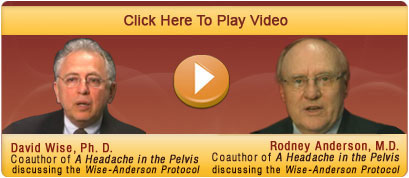
Dr. Rodney Anderson and Dr. David Wise, the developers of the Wise-Anderson Protocol for pelvic pain, include a discussion of the treatment of pelvic pain in women in the videos on the Wise-Anderson Protocol below.
Symptoms of Pelvic Pain in Women
Genital pain, anal and rectal pain, pain in the perineum, suprapubic (above pubic bone) pain, pain in bladder area, tail bone pain, groin pain, low back pain
Discomfort when sitting (often feels like a golf ball), post bowel movement pain
Urinary frequency, urgency, hesitancy, burning, frequent night time urination
Sexual pain including orgasm and post orgasm discomfort (often the next day)
Some women with muscle related pelvic pain say that they don’t actually feel pain but some variation of discomfort, aching, burning, fullness, squeezing, tightness, sharp or dull sensation.
JUST RELEASED
6th Edition of A Headache in the Pelvis, 6th edition
and Paradoxical Relaxation
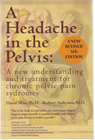
The Wise-Anderson Protocolwas developed at Stanford University by Dr. Rodney Anderson and Dr. David Wise in the Department of Urology. Drs. Anderson and Wise discuss pelvic pain and its treatment with the Wise-Anderson Protocolin detail in their book, A Headache in the Pelvis, which is now in its 6th edition. You may order the book below:
$19.95 Best price on the Internet
Limited time only
$11.95
"After reading over the 6th edition of “A Headache in the Pelvis,” all I can say is “Wow”…Drs. Wise and Anderson have done it again! This has truly become the “Bible” for patients, both men and women, who suffer from pelvic floor muscle dysfunction. The book demystifies a condition that is so frequently overlooked and often mistreated in clinical practice. It empowers the patient to be their own caregiver; while it encourages partnerships with clinicians who can be tremendously helpful in the patient’s path to symptom improvement. “A Headache in the Pelvis” is on the top of my recommendation list."
Robert Moldwin, MD Author, The Interstitial Cystitis Survival Guide
“This is a book that helps patients empower themselves in their own healing. With this book, patients learn how to gain control ov er their chronic pelvic pain. It is not a hocus-pocus solution, it is a long-term program that must be adapted into one’s daily routine. I have witnessed firsthand how patients willing to change their behavior have been able to find healing…When I see patients after they’ve read the book I can often see a change in their faces. To understand that we have the ability to affect our own healing process can be life changing.”
Ragi Doggweiler, MD
Associate Professor
Director of Neuro-Urology and Integrative Medicine, Division of Urology
University of Tennessee, Knoxville, TN
“This book that David Wise has written on relaxation training clearly is not an abstract rendering of a theoretical position, but the record of lessons personally learned, and here taught. Dr. Wise has distinguished himself by co-developing a successful treatment for chronic pelvic pain syndromes at Stanford University called the Wise-Anderson Protocol. Paradoxical Relaxation is a careful exploration of one of the methods of this innovative protocol and a departure from conventional relaxation training for anxiety."
Alan Leveton, M.D.
Associate Clinical Professor
Pediatrics and Psychiatry (retired)
University of California, School of Medicine,
San Francisco
Symptoms associated with
pelvic pain in women
Urinary frequency
(need to urinate more than once every two hours)
Urinary urgency (hard to hold urination once urge occurs)
Discomfort or pain in the rectum (feels like a “golf ball” in the rectum)
Sitting is uncomfortable or painful
Pain or discomfort during or after sexual activity or orgasm
Vaginal discomfort or pain (at the opening or internally)
Pubic bone or bladder discomfort or pain (suprapubic pain)
Perineum discomfort or pain (area between the vagina and anus)
Tailbone discomfort or pain (coccygeal pain)
Low back discomfort or pain (on one side or both)
Groin discomfort or pain (on one side or both)
Pain or burning during or after urination (dysuria)
Pain or discomfort with alcohol, caffeine and spicy foods
Frequent night time urination (nocturia)
Reduced urinary stream
Sense of incomplete urination
Hesitancy before or during urination or difficulty starting
urination
Reduced sex drive and anxiety about having sex (reduced libido)
Discomfort or relief after a bowel movement
Anxiety and pessimism about condition
Depression
Social withdrawal and impairment of intimate relations
Loss of self-confidence
Hot bath, shower or heat temporarily helps alleviate symptoms
Valium, Xanax, Ativan, Clonipin, Ambien (benzodiazepines) temporarily can reduce symptoms (but are not recommended as any long term treatment)
REQUEST COPIES OF RESEARCH PUBLISHED
ON THE WISE-ANDERSON PROTOCOL
The success of the Wise-Anderson Protocol has been documented in research published in the Journal of Urology and presented in other scientific meetings. This research can be ordered in PDF form below.
The Key Insight of The Wise-Anderson Protocol
The central notion in this book is that there is a common factor that unites the different names: that there is a common effective treatment for many of them; and that the body and the mind are intimately involved in the cause and the treatment.
For many years, chronic pelvic pain syndromes have posed an enigma to the medical community. In men, nonbacterial prostatitis, for example, has routinely been confused with acute or chronic bacterial prostatitis even though an accurate and easy method for diagnosis has been available for years. At the same time, nonbacterial prostatitis, which makes up the overwhelming number of cases of prostatitis, tends to be regarded by doctors as a kind of wastebasket diagnosis for pelvic symptoms that the doctor does not understand or know how to treat. Gross pathology, as measured by the latest medical instruments, has not been able to explain the degree of suffering caused by these disorders.
What we are proposing in this book is that these conditions are rather like a headache, except the location of the headache is in the pelvis. Hence A Headache in the Pelvis is our title. A further implication from the title is that these disorders are problems of chronic muscle tension, which is often the basis of headaches. If chronic pelvic pain syndromes are, in fact, a headache in the pelvis, then treatment needs to be radically different from what has traditionally been followed.
A Headache in the Pelvis is the name we are giving to chronic pelvic pain syndromes where no gross pathology has been found. These syndromes often include pain and dysfunction related to urination, defecation, and sexual activity. This discomfort or pain and dysfunction occur in both men and women. One person may experience only one symptom while another may experience all symptoms. Sometimes symptoms inexplicably vary from day to day or week to week. Symptoms vary, as do their anatomical locations, yet we propose that the trigger for these symptoms is the same and a common effective treatment may exist for all of them.
National Center for Pelvic Pain Research, Box 54, Occidental, California 95465
• Telephone: 707 874 2225 • Fax: 707 874 2335
Email: ahip@sonic.net, Privacy Policy